
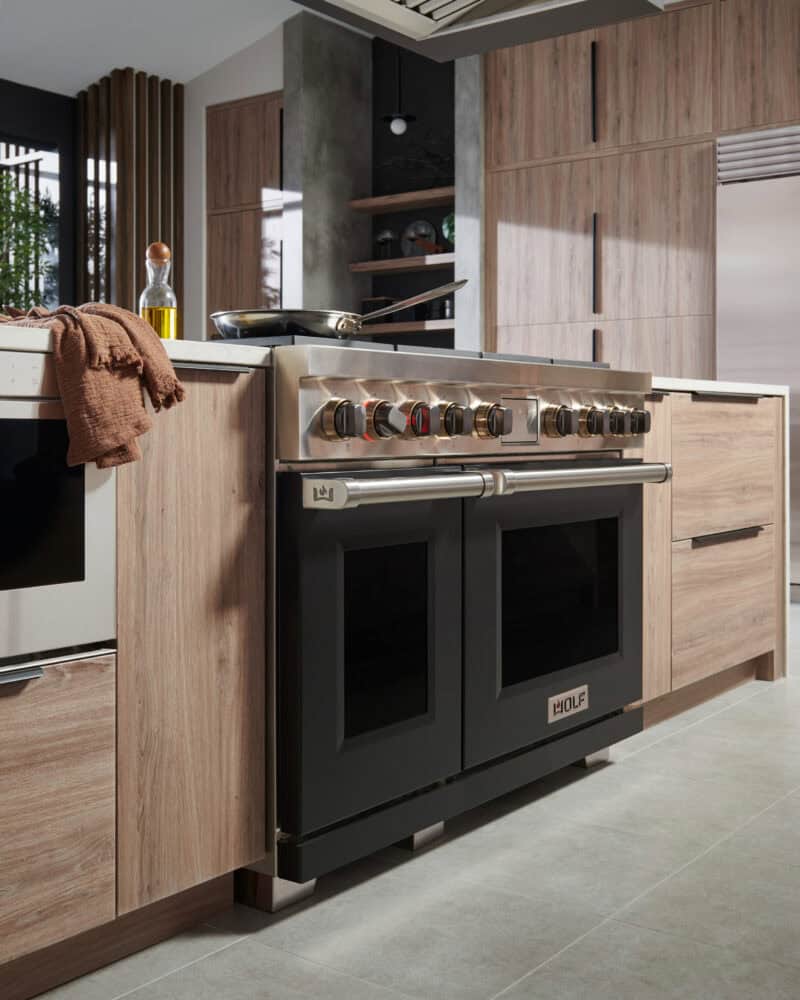
The short answer: induction ranges usually cost more upfront, including installation, but they run more efficiently over time — while gas ranges are often cheaper to install if a gas line already exists, but lose more energy as heat during cooking. Which one is actually more expensive for your kitchen depends less on the sticker price of the appliance and more on your home’s existing utilities, your local energy rates, and how long you plan to stay in the house. Here’s how the real costs break down.
In This Article
Upfront Appliance Cost: Gas vs. Induction
At the entry and mid-range level, induction ranges typically carry a higher price tag than comparable gas ranges — largely because of the electronics and induction coil technology packed beneath the cooktop surface. At the professional, luxury tier — where Clarke’s Wolf lineup lives — that gap does start to narrow. Gas and induction ranges of the same size and finish move closer together in price than you might expect at the entry level but induction is still considerably more expensive than gas. The exact difference will depend on size, configuration, and current model year, but budget-wise, it’s a meaningful distinction that’s worth factoring into your planning early.
Becuase pricing shifts with model updates and configuration, including fuel type, size, finish, and available features, the most reliable way to compare current pricing is with a Clarke consultant who can walk you through the specific models you’re considering side by side.
Installation Costs: What’s Actually Different
This is where the two technologies genuinely diverge — and it usually has more to do with your home’s existing infrastructure than the appliance itself.
Gas Range Installation
If your kitchen already has a gas line running to the range location, installation is typically straightforward and inexpensive. If a new gas line needs to be run from the meter or an existing gas appliance, costs commonly range from a few hundred dollars for a short, accessible run to well over $1,500–$2,500 when the line has to travel a longer distance, pass through finished walls or flooring, or requires permitting and inspection. Older homes and multi-story installations tend to land at the higher end.
Induction Range Installation
Induction ranges require a dedicated 240-volt electrical circuit, similar to an electric range. If your electrical panel already has available capacity nearby, adding that circuit is often a relatively modest electrician cost. If your panel is at capacity or far from the kitchen, you may be looking at a panel upgrade or a longer wire run, which can push costs significantly higher.
The Real Variable
In new construction or a full gut renovation, the cost difference between wiring for gas or induction is often minor — both are planned in from the start. In a lighter renovation of an older home, whichever utility you don’t already have tends to be the more expensive one to add. That’s usually the deciding factor, more than the appliance price itself.
Energy Efficiency and Ongoing Operating Cost
Once the range is installed, the ongoing cost comes down to efficiency and your local utility rates. According to U.S. Department of Energy testing, induction cooking elements convert roughly 70 to 74 percent of the energy they draw into heat delivered to the pan. Gas burners, by comparison, convert closer to 40 to 44 percent, with the remainder lost as heat that escapes around the pan and into the kitchen.
In practical terms, induction wastes far less energy per cooking session, directing more energy into the cookware rather than losing heat to the surrounding kitchen. The difference can be especially noticeable in kitchens that cook frequently and in bulk, with large stockpots, extended simmering, or daily meals for a busy household.
| Cost Factor | Gas Range | Induction Range |
|---|---|---|
| Typical upfront price (luxury tier) | Comparable | Comparable, sometimes slightly higher |
| Installation if utility already exists | Low | Low |
| Installation if utility must be added | Moderate–High (gas line run) | Moderate–High (240V circuit / panel capacity) |
| Cooktop cleaning & upkeep | Grates, burner caps, igniters | Smooth glass surface, no open flame |
Maintenance and Long-Term Ownership Costs
Gas ranges have more physical parts that can eventually need attention — burner caps, igniters, grates — though these are generally simple, inexpensive fixes on a well-built professional range. Induction cooktops have no open flame and a smooth glass-ceramic surface, which most owners find easier to keep clean day to day. That glass surface is durable but can be damaged by a dropped pan or heavy impact, which is worth factoring in if your household is hard on kitchen equipment.
Both technologies, properly maintained, hold up well over the life of a luxury kitchen. Neither has a meaningfully shorter lifespan than the other when installed and serviced correctly.
“The question we get isn’t ‘how efficient is induction’ — it’s ‘what’s this going to cost me.’ And the honest answer rarely has anything to do with the range itself. It comes down to whether your kitchen already has the gas line or the electrical capacity in place. That one detail tells us almost everything about the cost conversation.”
— Gina Saltarelli, Showroom Consultant, Clarke
Which Costs More in the Long Run?
If your kitchen already has a gas line, gas is typically the cheaper path upfront. If you’re renovating a kitchen that already has strong electrical capacity — common in newer homes and full renovations — induction can be the more economical choice once you account for installation. Over a decade or more of ownership, induction’s efficiency advantage can help close or even reverse the gap, particularly in regions where electricity and gas prices are close together.
There is no universal answer. The right way to compare cost for your specific kitchen is to look at your existing gas and electrical infrastructure, your local utility rates, and the exact models you’re considering — which is exactly what a showroom consultation is for.

Watch: Gas Vs Induction: Which Do Professional Chefs Prefer? — Clarke
See Both in Action Before You Decide
Cost comparisons only tell part of the story. Cook on both a Wolf gas range and a Wolf induction range in a working showroom kitchen before you choose.
Frequently Asked Questions
Is induction more expensive than gas overall?
Not always. Induction ranges and their installation are often more expensive upfront, especially if new electrical capacity is needed. But induction is significantly more energy efficient, so operating costs can be lower over time. Which one is “more expensive” depends on your existing utilities and local energy rates, not just the appliance price.
Does switching from gas to induction require an electrician?
Yes. Induction ranges need a dedicated 240-volt circuit. If your electrical panel already has capacity near the kitchen, this is a relatively simple job for a licensed electrician. If the panel is full or far from the kitchen, a panel upgrade or longer wire run may be needed, which adds cost.
How much does it cost to run a new gas line for a range?
A short, accessible gas line run is often a few hundred dollars. Longer runs, work behind finished walls or flooring, or permitting requirements can push the cost well over $1,500–$2,500. The exact cost depends heavily on your home’s layout and existing gas infrastructure.
Is induction cheaper to run than gas?
Induction converts significantly more of its energy into cooking heat — roughly 70 to 74 percent, compared to about 40 to 44 percent for gas, according to U.S. Department of Energy testing. Whether that lowers your bill depends on what you pay for electricity versus natural gas locally, since gas is often priced lower per unit of heat in many U.S. markets.
Do gas or induction ranges cost more to maintain?
Gas ranges have burner components — grates, caps, igniters — that occasionally need attention, though repairs are typically simple. Induction cooktops have a smooth glass surface with no open flame, which is generally easier to maintain day to day, though the glass can be damaged by heavy impact.
Should I choose gas or induction based on cost alone?
Cost is one factor, but most homeowners ultimately choose based on how they cook. Reviewing both your budget and your cooking style with a Clarke design consultant, and testing both technologies in person, gives a clearer answer than cost alone.
See both technologies for yourself. Book an appointment at a Clarke showroom before you decide.