
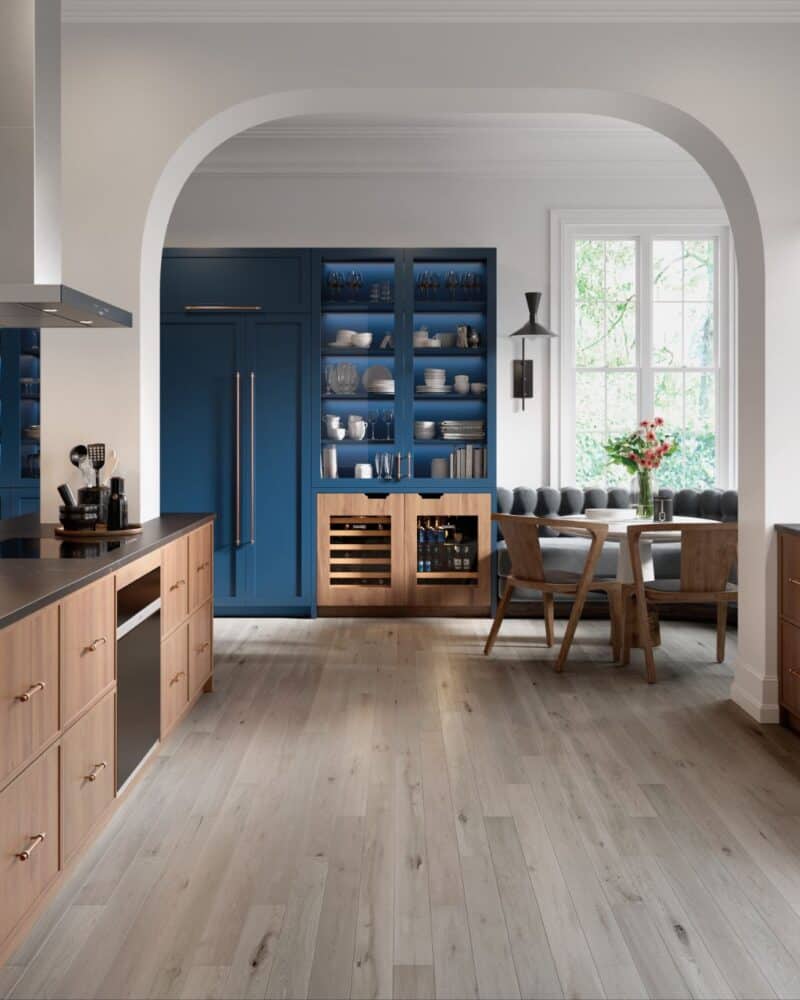

Planning a kitchen renovation without a clear kitchen layout strategy is one of the most common — and costly — mistakes homeowners make. Decisions about cabinetry, countertops, and finishes feel concrete and visible. But the decisions that actually determine whether a kitchen works happen earlier, in the planning phase, before a single cabinet is ordered or a wall is touched.
This kitchen planner guide walks through how to approach your layout with intention. It covers the sequencing that matters, the decisions that are hardest to reverse, and the planning steps that make the difference between a kitchen that looks beautiful and one that functions beautifully every day.
Why a Kitchen Planner Matters Before Renovation Begins
Most homeowners think of a kitchen planner as a tool for arranging cabinets. It is actually a framework for decision-making. A good kitchen planner forces you to think about how the space will be used, who will use it, and what physical constraints the room presents before any materials are selected.
Luxury kitchen design is built on this foundation. The layouts that feel effortless — where prep flows naturally into cooking, where guests can gather without crowding the range, where everything is in reach when you need it — are not accidents. They are the result of careful planning that began with how the kitchen would function, not how it would look.
When renovation planning starts too late or skips layout thinking altogether, the result is almost always a kitchen that forces compromise. Expensive appliances get crowded into ill-fitting spaces. Islands block traffic flow. Ventilation systems fight ceiling heights that were never accounted for. A kitchen planner approach, used early and seriously, prevents all of it.
Start With How You Actually Cook
Before sketching a single layout, consider your real cooking habits. How many people cook at once? Do you entertain regularly, or is the kitchen primarily for everyday family use? Do you bake? Do you cook high-heat, high-smoke dishes that demand serious ventilation? Do you need refrigeration in more than one location — say, a beverage column near the island and a full refrigerator-freezer column near the prep zone?
These questions sound simple. The answers shape every layout decision that follows.
A kitchen designed for serious daily cooking looks different from one designed for occasional entertaining. Both can be exceptional luxury kitchen designs. But they require different configurations, different appliance selections, and different priorities when trade-offs arise. Knowing which kitchen you are building before you start planning is the most important step in the process.
Plan Your Kitchen Layout Around Appliances, Not After Them
In luxury kitchen design, appliances are structural elements. They are not selected at the end of the process to fill the spaces cabinets left behind. They are selected first, because they determine where everything else goes.
A professional-grade range, a 48-inch Wolf range, for example, requires a hood sized and positioned to match, a gas or electrical supply of the right specification, and clearances that affect adjacent cabinetry. Sub-Zero refrigeration columns change the symmetry of an entire wall. A built-in coffee system, speed oven, or warming drawer each require their own planning for power,cabinet design, and access.
When appliances are chosen early, the kitchen layout can be built around them correctly. Cabinet dimensions, countertop overhangs, and wall configurations are all informed by real measurements and real requirements. When appliances are chosen late — after the layout is locked and cabinetry is on order — the result is compromise at every turn.
Use our kitchen planner to browse appliance models and sizes to help plan your kitchen layout before the work starts.
The Working Triangle and Why It Still Matters in Luxury Kitchen Design
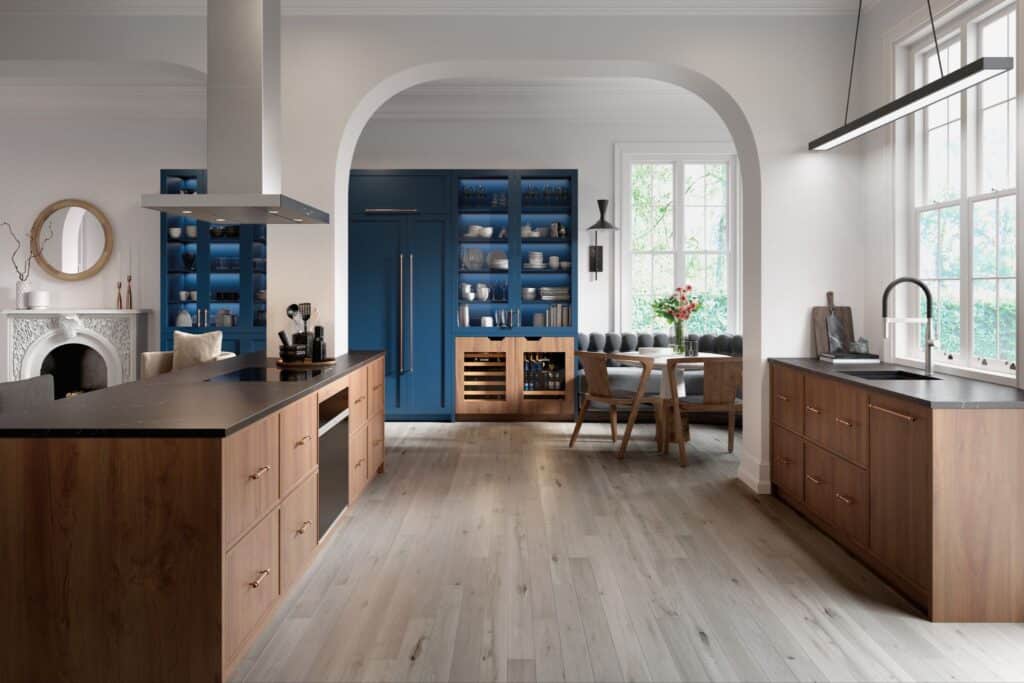
The kitchen work triangle — the relationship between the refrigerator, range, and sink — has been a foundational concept in kitchen layout planning for decades. In luxury kitchen design, the principle holds, but the execution is more nuanced.
Modern kitchens often serve multiple cooks and multiple purposes simultaneously. A single triangle no longer captures the full complexity. Luxury kitchen layout planning today considers multiple work zones: a primary cooking zone anchored by the range and hood, a prep zone near the refrigerator and sink, a cleanup zone centered on the dishwasher and secondary sink if present, and a social zone that allows guests to participate without entering the active cooking area.
Each zone should be thoughtfully connected to the others while maintaining enough separation to allow different activities to happen at the same time. This is what separates a kitchen that works from one that merely fits.
Think beyond the triangle — consider a linear kitchen island
For decades, kitchen design has revolved around the “work triangle” — positioning your sink, cooktop, and refrigerator at three separate points to minimize steps between them. While the kitchen triangle is still a reliable approach, But a growing number of designers and homeowners are rethinking that approach in favor of something more intuitive: linear cooking.
The idea is simple. Rather than moving between three distinct zones, everything — prep, cooking, serving, and cleanup — happens along a single, continuous workspace. When a well-designed island brings those functions together in one place, the kitchen becomes more efficient, less chaotic, and a lot more social. Multiple people can work side by side without getting in each other’s way, and you stay connected to your guests instead of disappearing behind a wall of tasks.
If you’re planning a renovation, it’s worth asking whether your island is doing as much as it could. The appliances you choose, and how they’re sized and arranged, play a big role in making that kind of layout work.
Getting Kitchen Island Sizing Right
The kitchen island is the most frequently misplanned element in luxury kitchen design. It is also the one homeowners most consistently want to make larger. The mistake is understandable — a larger island feels like more storage, more prep surface, more seating. What a poorly sized island actually creates is a kitchen that feels crowded, moves poorly, and fails to function the way it was intended.
Proper clearance around an island is not a suggestion. It is a functional requirement. Walkways need to accommodate movement for multiple people, appliance door swing, and the natural choreography of a kitchen in use. The island should serve the kitchen. When it is oversized, it dominates the kitchen instead.
When planning island sizing, work from the clearances outward — not from the island inward. Determine what the traffic paths require, what appliances need door swing access nearby, and what the room’s actual dimensions allow. Then size the island to fit what remains. The result will be a kitchen that feels generous and easy to move through, even when it is busy.
Storage Planning in a Luxury Kitchen Layout
Storage in luxury kitchen design is not about volume. It is about access. Deep drawers near the range for pots and pans. A pantry positioned in relation to how you unload groceries. Refrigeration zoned for the way meals are actually assembled. Appliance garages that keep counters clear without putting tools out of reach.
The best kitchen layouts are built around the principle of reducing friction. You should not have to walk across the kitchen to find what you need in the middle of cooking. Storage decisions made during the planning phase — not after cabinets are built — are the ones that make a kitchen feel intuitive rather than exhausting.
Ventilation and Lighting Belong in the Kitchen Planner, Not at the End
Two elements that are consistently planned too late in kitchen renovations: ventilation and lighting. Both are heavily influenced by the kitchen layout and both are very difficult to address correctly once construction is underway.
Ventilation must be matched to the cooking equipment being installed. A professional range generates heat, smoke, and steam at a scale that a standard residential hood cannot manage. The hood needs to be the right size, positioned correctly over the range, and connected to ductwork with adequate capacity. Ceiling height affects hood clearance. Cabinet placement above or alongside the range affects installation options. None of this can be figured out after the layout is finalized and the cabinets are ordered.
Lighting works the same way. Task lighting at the prep zone, ambient lighting for the overall space, accent lighting for open shelving or glass-front cabinets — all of it needs to be planned in relation to the layout. Electrical rough-in happens before drywall. Decisions made late mean retrofits that are expensive and often imperfect.
The Value of Seeing Your Kitchen Layout in a Real Space
A kitchen planner, whether a digital tool or a hand-drawn sketch, communicates dimensions. What it cannot communicate is scale. Understanding how a 48-inch range actually fills a wall, how refrigeration columns create visual balance on either side of a window, or how an island feels in relation to the surrounding space requires seeing it in person.
This is one of the most valuable reasons to visit a showroom before finalizing any luxury kitchen design decisions. At Clarke’s showrooms in Boston, Metro West, and South Norwalk, fully built kitchen environments allow homeowners to experience appliances at scale, understand how layout decisions translate into real space, and make choices grounded in firsthand experience rather than spec sheets.
Homeowners who visit Clarke’s showroom before their renovation begins consistently make better decisions. They understand what they are buying. They see how appliance selections interact with layout. And they arrive at the design phase with a clarity that makes the entire process smoother.
Schedule a showroom appointment at Clarke and bring your kitchen planner questions. Our consultants work with homeowners and designers at every stage of the planning process, from early layout thinking to final appliance selection.
When to Visit the Clarke Showroom in Your Kitchen Planning Process
The earlier in the process, the better. Ideally, a showroom visit happens before layout decisions are locked — when there is still flexibility to adjust zone placement, island sizing, or appliance wall configurations based on what you see and learn.
A showroom visit after construction has started is still valuable. But a visit during the planning phase, when your kitchen layout is still open to refinement, is where the most impactful decisions get made. Bring your floor plan. Bring your questions about specific appliance sizes. Come prepared to think about how you cook, not just about how you want your kitchen to look.
Clarke’s consultants are not salespeople who happen to know appliances. They are appliance specialists who understand how kitchen layout, workflow, and luxury kitchen design intersect. They can help you identify trade-offs you have not considered, flag conflicts between your layout and your appliance wish list, and make sure the planning decisions you make now do not create problems during construction.
A Kitchen Planner Approach That Carries Through the Whole Process
The best luxury kitchen renovations share a common quality: they were planned in sequence. Appliances were selected before cabinetry. Layout was finalized before electrical and plumbing rough-in. Ventilation requirements were established before the ceiling design was set. Storage was planned around how the kitchen would be used, not around what space was left.
A kitchen planner mindset, thinking through each decision in the order it actually affects the others, is what makes a renovation go smoothly. It is also what produces a kitchen that works as well as it looks.
Start planning your kitchen layout with Clarke’s Kitchen Planner.
Frequently Asked Questions
What should I decide first when planning a kitchen layout?
Start with appliances. Appliance dimensions, ventilation requirements, and utility needs drive every other layout decision — cabinetry, clearances, electrical, and plumbing. Selecting appliances first prevents costly revisions later in the process.
What is the ideal kitchen layout for a luxury renovation?
There is no single ideal layout. The right kitchen layout depends on room dimensions, how many people cook simultaneously, whether the kitchen opens to a living or dining area, and the specific appliances being installed. The goal is a layout that supports natural workflow and allows different activities to happen at the same time without congestion.
How much clearance does a kitchen island need?
Functional clearance around an island accommodates comfortable movement for multiple people, full appliance door swing, and the natural traffic patterns of a kitchen in use. Working from the clearances outward — rather than sizing the island first — produces better results.
Should I visit a showroom before finalizing my kitchen layout? Yes. Seeing appliances at scale in real kitchen environments provides a perspective that specs and renderings cannot. A showroom visit during the planning phase, before layout decisions are finalized, is when it is most valuable.
How does appliance selection affect kitchen layout planning?
Appliance dimensions determine cabinetry sizing, hood placement, utility requirements, and wall configurations. Selecting appliances after the layout is locked often results in compromises that affect both function and aesthetics. Appliances should drive the layout — not fit around it.
What is the role of a kitchen planner in a luxury renovation?
A kitchen planner provides the framework for sequencing decisions correctly. It ensures that layout, appliances, storage, ventilation, and lighting are all addressed in the order they actually affect one another — before construction makes changes expensive.