

When it comes to a luxury kitchen design, most homeowners spend months selecting appliances, finishes, and cabinetry and appliance placement comes after. It shouldn’t. Where your refrigerator, range, and dishwasher live in relation to each other will determine how comfortable and functional your kitchen feels every single day.
The best kitchen layout isn’t just about aesthetics. It’s about how you actually move through your kitchen when you’re cooking, cleaning up, and entertaining. This guide covers what our consultants at Clarke consistently recommend if you’re in the process of a luxury kitchen renovation — and the placement mistakes we see most often.
Start with the Kitchen Work Triangle (Then Move Beyond It)
The classic “kitchen work triangle” — the relationship between the refrigerator, range, and sink — has guided kitchen design for decades. The idea is simple: keep these three points close enough together that you’re not walking long distances while cooking, but far enough apart that multiple people can work without crowding each other.
In a well-designed kitchen, the total perimeter of the triangle should fall between 12 and 26 feet. Each leg of the triangle should be between 4 and 9 feet.
That said, the work triangle is a starting point, not a rule. Modern luxury kitchens — especially open-concept layouts and kitchens designed for serious entertaining — often benefit from a “zone” approach instead.
Think in Zones, Not Just Triangles
A zone-based layout organizes your kitchen around how it actually gets used:
- Preparation zone: Counter space near the refrigerator and sink — where you wash, chop, and stage ingredients before cooking.
- Cooking zone: The range or cooktop and wall oven, ideally with counter space on both sides for landing hot cookware.
- Cleanup zone: The sink and dishwasher together, positioned so the dishwasher door opens without blocking main traffic flow.
- Storage zone: Pantry, refrigerator, and specialty units like a beverage refrigerator or Sub-Zero undercounter refrigerator drawers.
For luxury kitchens designed to accommodate multiple cooks or frequent entertaining, clearly defined zones make the space work harder and feel less chaotic.
Refrigerator Placement: The Anchor Point
The refrigerator is typically the largest appliance in the kitchen, and its placement anchors the entire layout. A few principles that hold up across almost every kitchen design:
- Keep it near the entry point. Placing the refrigerator close to where you enter the kitchen — whether from a garage, pantry, or the main door — makes unloading groceries easier and reduces the amount of traffic you bring into the main cooking area.
- Leave counter space opposite the hinge side. You want a landing surface next to the side where the door opens so you have somewhere to set things down while loading and unloading.
- Consider column refrigeration. Sub-Zero column refrigerators and freezers allow you to separate refrigeration and freezer storage and place them independently — which opens up design flexibility that a traditional fridge-freezer combo doesn’t allow.
Range and Cooktop Placement: Where the Kitchen Comes Alive
The range — or cooktop paired with wall ovens — is the heart of any luxury kitchen. Placement here has real implications for safety, ventilation, and how the space feels socially.
- Allow clearance on both sides. Industry standards call for at least 15 inches of counter space on one side of a cooktop, but in a luxury kitchen, more is better. You want room to set down hot pans, prep ingredients, and work comfortably without bumping into adjacent cabinetry.
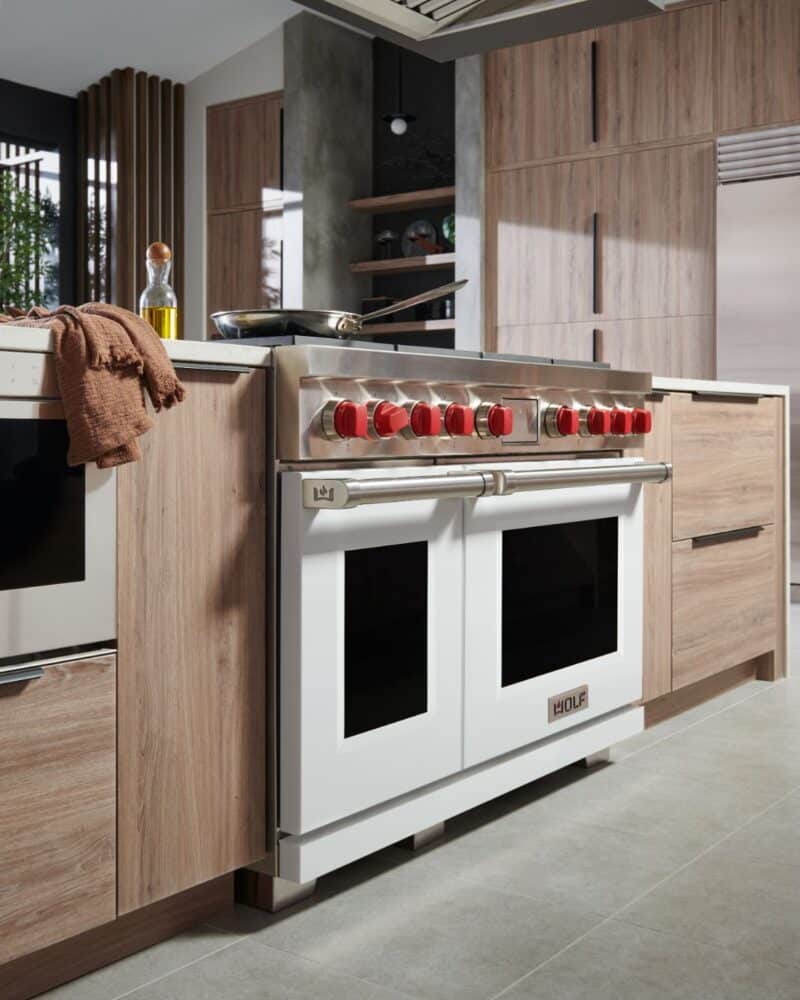
- Plan ventilation first. Your range placement is largely dictated by where you can run a duct. A Wolf range or cooktop paired with proper ventilation is one of the most important decisions in the kitchen — don’t let cabinetry constraints force a compromise here. If you’re doing an island cooktop, plan for a ceiling-mounted or island vent hood from day one.
- Island placement creates a social kitchen. Moving the cooktop to an island keeps the cook facing the room and guests, which is why it’s become the default in open-concept luxury kitchens. The tradeoff is ventilation complexity and the fact that an island range leaves the perimeter walls free for other appliances and storage.
Wall Ovens: The Most Underestimated Layout Decision
Separating the oven from the cooktop — using a wall oven tower rather than a freestanding range — is one of the single best decisions you can make in a luxury kitchen renovation. Here’s why:
- Ergonomics: A wall oven installed at the right height means you’re not bending down to check on dishes or pulling heavy pans out at floor level. For anyone who does serious cooking, this matters enormously.
- Multiple ovens: A wall oven column allows you to stack two ovens — invaluable for entertaining. A Wolf double wall oven in a column gives you far more flexibility than a range ever could.
- Separation of workflows: With a wall oven away from the cooktop, two cooks can work simultaneously without interfering with each other.
The catch: wall ovens need to be placed with landing space nearby. Don’t position a wall oven where the only adjacent surface is a door swing or a high-traffic walkway.
Dishwasher: Often Placed Wrong
The dishwasher is probably the most routinely misplaced appliance in kitchen design. Two rules that solve most problems:
- Put it next to the sink. You rinse things at the sink before loading the dishwasher, and you unload clean dishes to the cabinets above. Placing the dishwasher on the same side of the sink as the main cabinet storage cuts the number of steps this takes in half.
A Cove dishwasher, designed specifically to complement Sub-Zero and Wolf appliances, is worth seeing in person — the door panel options integrate seamlessly with cabinetry when placed correctly.
Specialty Appliances: Don’t Treat Them as Afterthoughts
In a luxury kitchen, specialty appliances — beverage refrigerators, ice makers, warming drawers, steam ovens — deserve as much placement thought as the main appliances.
- Beverage refrigerators work best near the entertaining end of the kitchen — in an island, or near the transition point between the kitchen and a living area. Read more about where and why to include a beverage refrigerator in your kitchen design.
- Warming drawers should sit near the range or oven so dishes can move directly from cooking to holding without a long carry.
- Steam ovens are most useful near the main cooking zone, where they can be used for finishing, reheating, or as a primary cooking method.
The Showroom Advantage: See It Before You Finalize It
No floor plan fully prepares you for how a kitchen layout actually feels to move through. One of the most valuable things you can do before finalizing your design is walk through a working kitchen showroom and experience the spacing, appliance placement, and workflow in a real environment.
At Clarke, our showrooms in Boston, Metro West, and South Norwalk are working kitchens — not static displays. You can open the refrigerator, pull out the oven racks, and stand in the space to understand how it actually functions.
Our consultants work with homeowners at every stage of the design process — from early planning conversations to final appliance selection. Schedule a showroom appointment to start the conversation, or explore our full range of luxury kitchen design resources to continue planning.

Frequently Asked Questions
What is the best kitchen layout for a luxury kitchen?
There’s no single best layout — it depends on the size and shape of your space, how many people cook at once, and how you entertain. L-shaped and U-shaped kitchens work well for single cooks, while kitchen islands with a cooktop or prep area excel for entertaining. The most important thing is that the work triangle or zone layout is efficient and doesn’t force long crossings between the refrigerator, range, and sink.
How much counter space should I have on each side of the range?
Industry standards recommend at least 15 inches of counter space on one side of a cooktop. In a luxury kitchen, aim for more — 18 to 24 inches on each side is ideal. This gives you room to prep, set down hot pans, and work comfortably without feeling crowded. Never position a range or cooktop directly against a wall or cabinetry with no adjacent landing surface.
Should the refrigerator be near the entrance of the kitchen?
Generally, yes. Placing the refrigerator close to the kitchen entrance or the point where groceries arrive makes unloading and restocking much easier. It also reduces the amount of traffic moving into the main cooking zone. For households with children, a refrigerator near the entry means drinks and snacks can be accessed without anyone walking through the cooking area.
Where should a wall oven be placed in the kitchen?
Wall ovens should be installed at a comfortable height — typically so the oven window is at or just below eye level — and positioned near a landing surface where hot dishes can be set down safely. Avoid placing wall ovens at the end of a run where the only adjacent surface is a traffic corridor. A wall oven column with drawer storage below is one of the most practical configurations in a luxury kitchen.
Is a kitchen island a good place for a cooktop?
Yes, in many luxury kitchen designs. An island cooktop keeps the cook facing the room during meal preparation — a significant advantage for entertaining. The tradeoff is ventilation complexity; island installations require a ceiling-mounted or island vent hood, which needs to be planned early in the design process. If ventilation is properly addressed, an island cooktop is one of the most social and functional layouts available.
How do I decide on the right appliance layout before my kitchen is built?
The best thing you can do is walk through a working kitchen showroom before your cabinetry is finalized. Seeing appliances at full scale — and moving through a real kitchen environment — reveals things that floor plans don’t. Clarke’s showrooms in Boston, Metro West, and South Norwalk are working kitchens where you can experience layout and scale firsthand. Schedule an appointment with one of our consultants to talk through your specific space.