
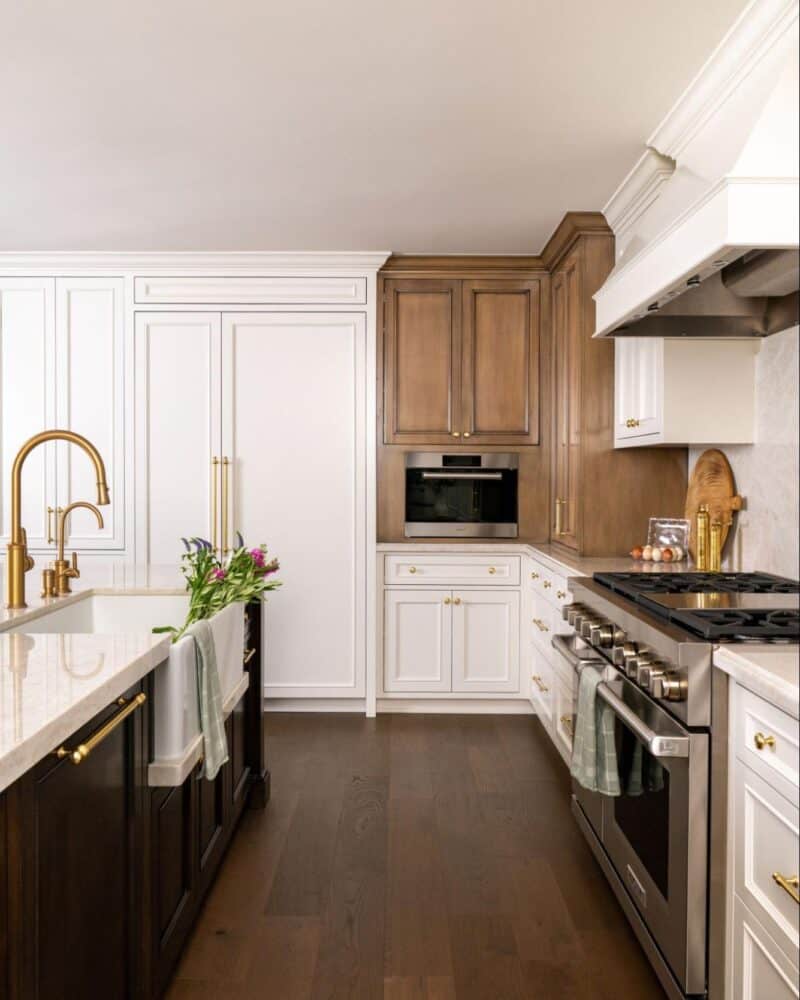

If you’ve spent any time researching luxury kitchen appliances, you’ve probably come across the term “panel ready.” It sounds straightforward, but there’s more to it than simply covering an appliance with a cabinet panel. Understanding what panel ready refrigeration actually involves — and whether it’s right for your kitchen — can save you a lot of time and expense down the road.
Here’s what our consultants at Clarke walk homeowners through every week.
What Does “Panel Ready” Actually Mean?
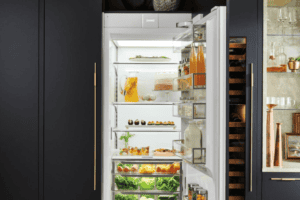
A panel ready refrigerator is designed to accept a custom cabinet panel on its door, so the appliance blends into the surrounding cabinetry. Instead of a visible stainless steel exterior, you see the same wood, paint, or finish as the rest of your kitchen cabinets.
The refrigerator itself is fully functional — the panel is purely aesthetic. Your cabinetmaker or kitchen designer provides the panel, which is mounted to the appliance door using an attachment system built into the unit. When done well, the refrigerator disappears into the kitchen, and you’d never know it was there until the door opened
This is different from “integrated” refrigeration, which we’ll come back to in a moment.
What’s the Difference between Panel Ready vs. Built-In vs. Integrated Refrigeration?
These three terms are often used interchangeably, but they describe different things:
- Panel ready: The appliance accepts a decorative panel that matches your cabinetry. The unit may still protrude slightly from the cabinet face.
- Built-in: Designed to fit flush with surrounding cabinetry, with a consistent depth. Sub-Zero built-in refrigerators, for example, are engineered to a depth that aligns with standard cabinet faces — typically around 24 inches. They can be ordered with stainless steel or panel ready doors.
- Integrated / Fully integrated: Fully flush with the cabinetry — door, hinges, and all. The appliance face is entirely hidden.

Most panel ready refrigerators in the luxury space — including Sub-Zero’s built-in or integrated lines — fall into the “built-in, panel ready” category. They sit flush with the cabinets and accept a custom panel, achieving a seamless look.
Why Choose Panel Ready?
The primary reason homeowners choose panel ready refrigeration is design continuity. In a kitchen where every detail has been considered — the cabinetry, the hardware, the countertop edges — a stainless steel refrigerator standing out from the cabinet line can feel like a disruption.
Panel ready refrigeration solves this. It allows the kitchen to read as a unified, cohesive space rather than a collection of individual appliances. This matters particularly in:
- Open-concept kitchens where the kitchen is visible from living areas — visual coherence carries more weight when the room is seen from multiple angles.
- Contemporary or transitional kitchens with flat-front cabinetry where the clean lines would be interrupted by a visible appliance.
- Kitchens with bold or distinctive cabinetry — deep colors, specialty wood, painted finishes — where maintaining that visual statement throughout the space is part of the design intent.
Is Panel Ready More Expensive?
Yes, but not necessarily because of the appliance itself.
In many cases, a panel-ready refrigerator actually costs the same as — or even less than — the stainless steel version. The primary added cost comes from the custom cabinetry panel and installation work required to create a fully integrated look.
That panel is typically built by your cabinetmaker to match the surrounding cabinetry. If you’re already investing in custom cabinetry as part of a kitchen renovation, the additional cost is often modest. In an existing kitchen, however, creating a matching panel and coordinating installation can be more complex, which may increase the overall project cost.
The result is a seamless, built-in appearance that many homeowners feel is worth the added investment if there even is one, particularly in luxury kitchen designs.
It’s also worth noting that panel ready appliances add a step to any future servicing. Because the panel is mounted to the door, it needs to be removed for certain service procedures though it’s usually avoided if possible. Clarke’s factory-certified service team at Clarke Customer Care is experienced with panel ready appliances and handles this when necessary.
What Are the Limitations?
Panel ready refrigeration isn’t for every kitchen or every homeowner. A few honest considerations:
- Lead time: Custom panels should be on the same timeline as the rest of your kitchen’s cabinetry.
- Replacement complexity: If you ever replace the appliance years down the road, the new unit needs to be compatible with your existing panel, or a new panel needs to be fabricated.
- It requires a good cabinetmaker: The panel needs to be precisely made and installed. A poorly fitted panel looks worse than a stainless door. This is not a DIY project.
- Stainless still looks great: If you love the look of stainless appliances and your kitchen design calls for them, there’s no reason to pursue panel ready. It’s a design choice, not a quality indicator.
Which Sub-Zero Refrigerators Are Available Panel Ready?
Most of Sub-Zero’s refrigerator lines are available in panel ready configurations. This includes:
- Subzero Designer Series refrigeration, Columns and Tall units — The column lineup allows you to place refrigeration and freezer storage separately, each with its own panel. This is one of the most design-forward approaches to refrigeration in a luxury kitchen.
- Subzero Classic series refrigeration — Available with stainless or panel ready doors.
- Subzero Designer Series: undercounter models, including wine storage undercounter as well.
The best way to understand the size and visual impact of these units is to see them in person. At our Clarke showrooms, panel ready installations are displayed in working kitchen environments so you can see exactly how the integration looks in context.
Thinking Through Your Refrigeration Plan?
Panel ready refrigeration is one decision within a larger set of refrigeration choices — how much capacity you need, whether you want column or traditional configuration, where undercounter units might solve specific storage problems. Our consultants are equipped to walk through all of it.
Schedule a showroom appointment at our Boston, Metro West, or South Norwalk location to see panel ready refrigeration in a working kitchen setting — and get honest answers to whatever questions you have.
You can also explore our full range of Sub-Zero refrigeration options to start understanding what’s available.
Frequently Asked Questions
What is a panel ready refrigerator?
A panel ready refrigerator is designed to accept a custom cabinet panel on its door so the appliance blends seamlessly into your cabinetry. Rather than a visible stainless steel exterior, the refrigerator door shows the same finish as your surrounding cabinets. The panel is fabricated by your cabinetmaker and mounted to the appliance door using an attachment system built into the unit.
What is the difference between panel ready and integrated refrigerators?
Panel ready means the appliance accepts a decorative cabinet panel, but may still sit slightly proud of the cabinet face. Fully integrated means the appliance is flush with the cabinetry on all sides, including the door face and hinges — achieving a completely hidden look.
Does panel ready refrigeration affect service and repair?
The panel needs to be removed for certain service procedures, which adds a step to the process but this is generally avoided if possible. Clarke’s factory-certified service team at Clarke Customer Care is experienced with panel ready appliances and handles this as needed. It’s not a barrier to service — just something to be aware of.
Can I see panel ready refrigeration in person before deciding?
Yes. Clarke’s showrooms in Boston, Metro West, and South Norwalk display panel ready refrigeration in working kitchen settings. Seeing the actual integration in a real environment is one of the best ways to decide whether it’s right for your kitchen. Schedule a showroom appointment to see it firsthand.