
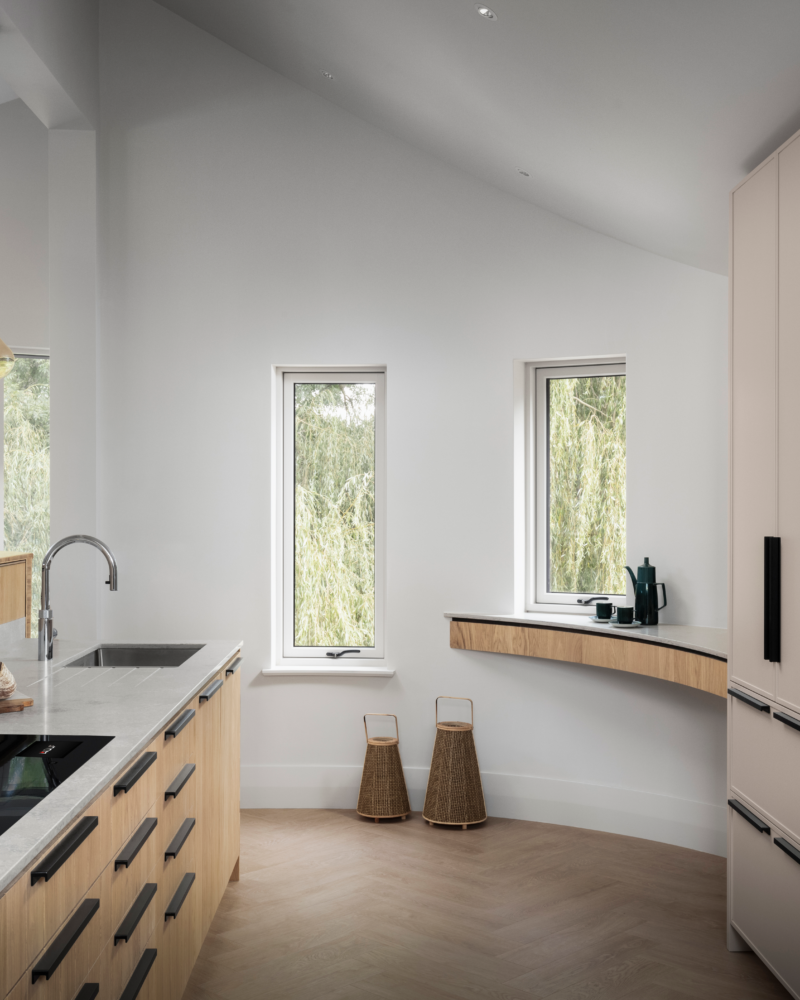
Featuring insights from Mark Haddad, Certified Master Kitchen and Bath Designer and founder of Interiology Design Co.
In a galley kitchen, every appliance does double duty. It has to perform — and it has to disappear into a layout where there’s no room for anything bulky, awkward, or purely decorative. Few people understand that balance better than Mark Haddad, founder of Interiology Design Co. and a Certified Master Kitchen and Bath Designer who has spent 25 years designing kitchens across Greater Boston, including dozens of galleys as small as 100 square feet.
We sat down with Haddad to talk through the appliance decisions that make or break a narrow kitchen — and the choices he comes back to again and again.

Induction Cooktops: “One of My Favorites. It’s a Go-To.”
If there’s one appliance Haddad recommends across nearly every galley project, it’s an induction cooktop — and the numbers back him up.
“Even people who use gas, we’re finding people who are gas cooks, when we renovate, are moving to induction. You have more control. It’s safer.”
For galley kitchens specifically, induction solves a problem that’s nearly universal in narrow spaces: a shortage of counter and prep surface. “Within a galley, it doubles as a counter surface, which is invaluable when you have limited counter space,” Haddad explains. “I’ve even had a wood chopping block made to cover it, and then they can put pans, and other things, right over it — especially if they’re serving a buffet or need presentation space.”
He also points to a safety benefit that matters increasingly to his client base. “We tend to design for a population that is planning to age in place — induction performs beautifully from a cooking perspective, and there’s a safety factor. You can’t leave it on, you can’t burn yourself on it.”
If you haven’t cooked on induction before, it’s worth experiencing firsthand. Clarke showrooms feature Wolf induction cooktops where you can see exactly how this technology works — and take it for a test drive — before you decide.
The Galley-Smart Alternative to a Range: Cooktop Plus Wall Oven
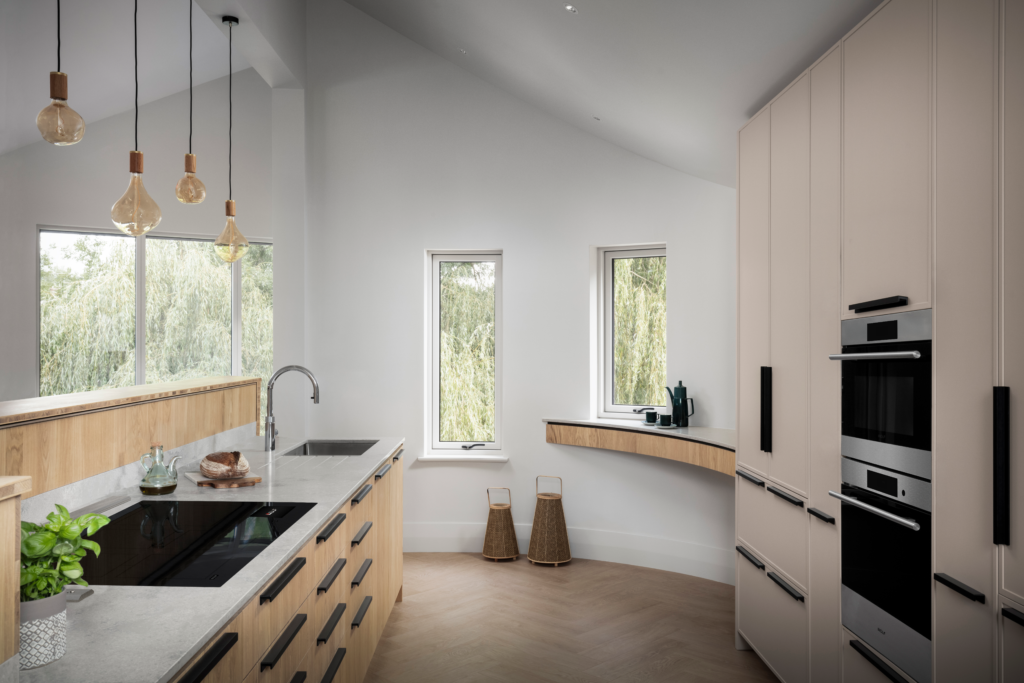
In larger kitchens, a single range — cooktop and oven combined — is often the default. In a galley, Haddad routinely recommends a different configuration.
“A range protrudes from the counter 2 to 3 inches. By using a cooktop with a wall oven installed beneath it, you get the function of all your cooking in one location without increasing the cabinet or countertop depth.”
Those few inches matter enormously in a space where every inch of clearance affects how comfortably two people can pass each other. Pairing a Wolf induction cooktop with a wall oven below keeps the cabinet line flush and the walkway clear — without sacrificing full cooking capability.
Panel-Ready Refrigeration: The Trick That Makes a Small Kitchen Feel Bigger
Photography by Jared Kuzia
Ask Haddad what makes a galley kitchen feel luxurious rather than cramped, and panel-ready appliances top the list.
“We panel appliances because you don’t want the kitchen to look too appliance-heavy. If you panel the refrigerator and fully integrate it — especially a Sub-Zero Designer Series, which fully integrates into the cabinetry, which can look like a cabinet if we use the Designer Series — and then if you integrate the cooktop with the oven underneath, that’s built-in. We panel a dishwasher. It gives you the illusion that the kitchen is larger than it is, because everything looks like cabinetry.”
This is one of the clearest examples of design and product working together: a panel-ready Sub-Zero refrigerator isn’t just a premium finish choice, it’s a functional strategy for making a narrow kitchen read as larger and more cohesive. Clarke showrooms have several examples of fully paneled Sub-Zero refrigerators integrated into kitchen displays — it’s the kind of thing you need to see in person to fully appreciate.
Refrigeration Layout: French Door vs. Single Door
Refrigerator door swing is a bigger deal in a galley than in almost any other layout, and Haddad walks every client through the trade-offs.
“The best type of refrigeration in a galley kitchen is a French door, because you don’t have the swing of the big door — half the width — so someone can pass by if the refrigerator’s opened.” For multi-person households navigating a tight walkway, the reduced door swing is often worth it.
For single-cook households, he often steers clients toward a full single-door refrigerator instead. “Especially the one-cook kitchens, they usually opt for the single door refrigerator, because the client feels, ‘If somebody’s walking through, they can wait.'”
It’s a small decision with an outsized impact on daily traffic flow — and exactly the kind of question a Clarke showroom consultant can help you think through before you buy.
Combination Ovens: Doing More With Less
Not every galley kitchen needs — or has room for — a full-size oven and a separate microwave. Haddad’s solution is a combination oven that handles both roles.
“If they say, ‘I’m not cooking Thanksgiving dinner, I don’t need a huge oven,’ we’ll use a combo oven, such as a speed oven. It allows them to have their microwave and their convection oven in one appliance. So it’s a space saver, and it functions just as well for either function or combined, however they want to use it.”
For galleys where a full-size oven is non-negotiable — large families, frequent entertaining — Haddad’s studio still tends to avoid traditional double ovens even in bigger kitchens. “Usually it’s a single convection oven, and then some kind of combination oven — whether it’s a combi-speed oven or a combi steam oven, if they want the convection and steam function and not the microwave function.”
Microwave Drawers: Solving a Problem Most People Don’t Think About
One detail Haddad raises unprompted, and one that’s easy for homeowners to overlook: where the microwave goes.
“Microwaves don’t have to — and should not — be over the stove, because it’s dangerous to pull things out, especially if they’re hot. It’s much better below the counter, and lift things to the counter.”
In several of his galley projects, a built-in microwave drawer solves this cleanly — tucked beneath the counter, out of the main sightline, and safer for households with children or anyone planning to age in place.
How Many Appliances Can Actually Fit?
Even with a long wish list, Haddad says galley kitchens tend to keep clients realistic — often before a single drawing is made.
But “realistic” doesn’t mean “compromised.” In one recent project — a roughly 750-square-foot one-bedroom condo — Haddad’s team fit a full-size 30-inch refrigerator-freezer, a full-size wall oven, a 30-inch induction cooktop, a full-size dishwasher, and a built-in microwave drawer, all within a closed galley layout. “The client’s goal was full-size appliances and was not interested in compact models”
The Order Matters: Appliances Before Cabinetry
Perhaps Haddad’s most important piece of advice has nothing to do with any single appliance — it’s about sequence. Appliance choices should come before cabinetry decisions, not after.
Cooktop depth, refrigerator door swing, oven placement, and ventilation all directly shape what’s possible in the cabinetry plan around them. Starting with appliances — and understanding how each one fits into the layout — gives a designer the flexibility to build everything else around the choices that matter most to how you’ll actually use the space.
As Haddad puts it: “You might do one, maybe two kitchen renovations in your lifetime. We’re doing a dozen a year.” Starting with the appliances, and starting with the right guidance, is how you make sure you only have to do it once.
See these appliances in person.
Reading about induction cooktops, panel-ready refrigeration, and integrated wall ovens is one thing — seeing how they fit together in a real galley layout is another. At Clarke , our showrooms feature fully functional Sub-Zero, Wolf, and Cove appliances in kitchen settings designed to help you visualize exactly how these choices translate to your own space.
Visit a Clarke showroom and take the ultimate appliance test drive — try an induction cooktop firsthand, see how a panel-ready Sub-Zero refrigerator integrates into cabinetry, and talk through your galley kitchen layout with one of our showroom consultants. No pressure, just the information you need to make confident decisions.
Frequently Asked Questions
What are the best appliances for a galley kitchen?
The appliances that work best in a galley kitchen are ones that minimize depth, reduce door swing, and ideally serve more than one function. An induction cooktop — particularly paired with a wall oven below it — keeps the cabinet line flush and frees up counter space when the cooktop isn’t in use. A panel-ready refrigerator integrated into the cabinetry reduces visual bulk. A combination speed oven or convection steam oven eliminates the need for a separate microwave. And a built-in microwave drawer tucked below the counter keeps the sightline clean and removes a safety hazard from above the stove. The right combination always depends on how the kitchen is used and how many people will be in it at once.
Is induction cooking better than gas in a small kitchen?
For most galley kitchen layouts, induction has a clear practical advantage over gas. An induction cooktop can sit completely flush with the counter surface, meaning it can double as prep or serving space when it’s not in use — something a gas cooktop can never do. There’s no depth penalty the way there is with a full range, which typically extends two to three inches beyond the counter. Induction is also safer in tight spaces, particularly for households with children or homeowners planning to age in place. That said, the best way to evaluate induction is to cook on one. Clarke showrooms feature Wolf induction cooktops where you can experience the performance firsthand before you decide.
What is a panel-ready refrigerator and is it worth it in a galley?
A panel-ready refrigerator is designed to accept a custom cabinetry panel on its door, so it blends seamlessly into the surrounding kitchen rather than reading as a separate stainless appliance. In a galley kitchen, where visual clutter directly affects how large or small a space feels, paneling the refrigerator — along with the dishwasher — can meaningfully change the perception of the room. Sub-Zero’s Designer Series is built specifically for this kind of full integration and is one of the most requested options among designers working in luxury narrow kitchens. Whether it’s the right choice for your project depends on your cabinetry style, layout, and budget — a showroom consultant can walk you through the options.
Should appliances be selected before cabinetry in a galley kitchen?
Yes — and this is one of the most important sequencing decisions in any kitchen renovation, but especially in a galley where space is constrained. The depth of your cooktop, the door swing of your refrigerator, the height and width of your wall oven, and the type of ventilation you choose all directly affect what the cabinetry around them can look like and how much counter space you’ll end up with. Choosing appliances first gives your designer — and your cabinet maker — the exact dimensions they need to build a layout that actually works. Choosing cabinetry first and then fitting appliances into whatever space is left is one of the most common and most costly mistakes in a kitchen renovation.
Can you fit a Sub-Zero refrigerator in a galley kitchen?
Yes, and designers working at the luxury level do it regularly. The key is choosing the right configuration. Sub-Zero offers column refrigerators and freezers, undercounter units, and a full range of widths — including 24-inch and 30-inch options — that can fit into a galley layout without overwhelming the walkway. Panel-ready finishes allow the unit to integrate fully into the cabinetry, so it doesn’t visually dominate a narrow space. The door swing configuration — and whether a French door, single door, or column layout makes the most sense for your traffic flow — is worth discussing with a consultant before you decide. Clarke showrooms carry the full Sub-Zero lineup and can help you find the right fit for your specific layout.
Where should a microwave go in a galley kitchen?
Avoid placing a microwave above the stove — especially in a galley kitchen where there’s limited room to maneuver. Reaching over a hot range to pull out a heavy dish is awkward at best, and most experienced kitchen designers will steer you away from it for that reason alone. Better options include a microwave drawer built into the base cabinetry, a combination speed oven integrated into a wall oven stack, or a compact microwave tucked into a dedicated lower cabinet. Any of these keeps the sightlines cleaner, the counters clearer, and the kitchen easier to move around in.
What size appliances work in a small galley kitchen?
Full-size appliances are achievable in most galley kitchens — the key is choosing the right ones and planning the layout around them from the start. A 30-inch refrigerator-freezer, a 30-inch induction cooktop, a full-size wall oven, a standard dishwasher, and a microwave drawer have all been successfully integrated into a galley kitchen. Compromising to undersized appliances is rarely necessary with good design — but trying to fit full-size appliances into a layout that wasn’t planned around them is where things go wrong. Start with the appliances, build the cabinetry around them, and bring in a professional designer before any decisions are finalized.
Is Wolf induction worth it in a galley kitchen?
Wolf induction cooktops are designed to perform at a professional level while sitting flush with the counter — which makes them particularly well-suited to galley kitchens where counter space is at a premium. The flush surface can be used as prep or serving space when the cooktop isn’t in use, and the precision heat control gives you the same responsiveness that gas cooks often cite as their reason for not switching. Clarke is New England’s official Sub-Zero and Wolf showroom, and our consultants can walk you through the full Wolf induction lineup — including live demonstrations — so you can experience the difference before you commit.