
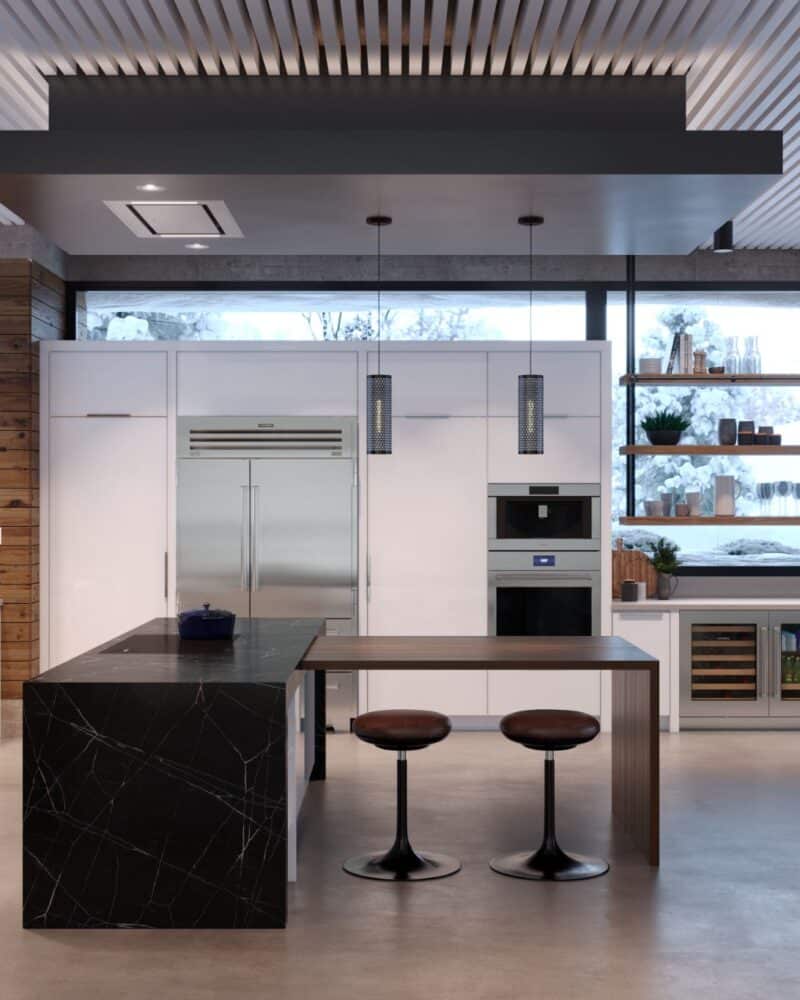

If you’re planning a kitchen renovation and wondering whether to include a dedicated beverage refrigerator, you’re not alone. It’s a question our consultants at Clarke field regularly — and the honest answer is that it depends entirely on how you use your kitchen and how you entertain.
A beverage refrigerator is not a luxury indulgence for everyone. For the right household, it’s genuinely useful. For others, it’s an appliance that takes up cabinet space and adds a line item to a budget that’s already stretched. Here’s how to think through the decision.

What Is a Beverage Refrigerator?
A beverage refrigerator is a compact, dedicated refrigeration unit designed to store drinks at their optimal serving temperature. Unlike a standard refrigerator, which is set to 37°F for food safety, a beverage refrigerator typically operates between 35°F and 50°F, to account for different drink types.
Most beverage refrigerators are designed to be installed undercounter, either in a kitchen island, at the end of a run of base cabinets, or in a bar area. Sub-Zero’s undercounter beverage center is a popular choice in luxury kitchens — it’s available panel ready, built to match the depth of standard cabinetry, and engineered with the same preservation technology as Sub-Zero’s full-size refrigerators.
Who Actually Benefits from a Beverage Refrigerator?
Not every household needs one. But you’ll get real value from a dedicated beverage refrigerator if:
- You entertain regularly. If you host dinner parties, holiday gatherings, or casual get-togethers with any frequency, a dedicated beverage station means guests can help themselves without opening your main refrigerator. This keeps the main fridge organized and gives guests independence — both of which matter during a party.
- Your main refrigerator is frequently full. In a busy household, a full refrigerator is a constant source of frustration. Adding undercounter beverage storage offloads a significant volume — drinks are one of the bulkiest things most refrigerators hold.
- You care about serving temperature. Water, white wine, sparkling water, and beer are each ideally served at different temperatures. A beverage refrigerator with dual or variable temperature zones lets you store each at the right temperature rather than the compromise setting of your main fridge.
- You have a kitchen island or bar area. If your kitchen includes an island or a transition to a bar or living area, a beverage refrigerator built into that space creates a natural serving station that keeps traffic out of the main cooking zone.
- You’re already doing a full renovation. Adding undercounter refrigeration is far easier — and cheaper — during a renovation than retrofitting it later. If the question is on your mind now, it’s worth deciding before cabinets are built.
Who Probably Doesn’t Need One
Equally important: a beverage refrigerator isn’t right for every kitchen.
- If you rarely entertain at home, the convenience factor is minimal. The space could serve you better as a drawer or cabinet.
- If your kitchen is small, every undercounter inch counts. In a galley kitchen or a compact space, dedicating 24 inches of base cabinet to a beverage refrigerator may not be worth the tradeoff.
- If your main refrigerator already has adequate capacity, you may find that you use the beverage refrigerator so infrequently that it becomes a source of energy draw and appliance maintenance without delivering much value.
Built-In vs. Freestanding Beverage Refrigerators
If you decide to include a beverage refrigerator, you’ll choose between built-in (undercounter) and freestanding models. For a kitchen renovation, built-in is almost always the right choice:
- Built-in units are designed for undercounter installation with front ventilation, so they can be enclosed in cabinetry without overheating. They integrate flush with cabinet lines and are available panel ready for a seamless look.
- Freestanding units vent from the back or sides and need clearance on all sides. They’re fine in a utility room, garage, or basement bar, but they don’t belong inside cabinetry — they’ll overheat and fail prematurely.
If you’re doing a full kitchen renovation with custom cabinetry, a built-in beverage refrigerator is the obvious choice. The Sub-Zero 24″ undercounter beverage center is engineered for exactly this application — true undercounter installation, panel ready, and built to the same standards as Sub-Zero’s full refrigeration lineup.
Where Should a Beverage Refrigerator Go?
Beverage refrigerator placement matters as much as the unit itself. The most functional locations:
- In the kitchen island, positioned toward the end closest to the dining or living area. This creates a natural drink station that guests can access without entering the main cooking zone.
- At the end of a base cabinet run, particularly near a transition to an adjacent room or a bar area.
- In a dedicated bar or butler’s pantry, if your home has one — this is the ideal scenario, where the beverage refrigerator is entirely separate from the main kitchen workflow.
The goal is to place it where it serves the activity it supports — entertaining — rather than in the middle of the main cooking zone where it becomes an obstacle.
What About Wine Storage?
A beverage refrigerator is not the same as a wine refrigerator, though some units handle both. Red wine is ideally stored between 55–68°F while white wine is ideally stored between 44–55°F.
Depending on your wine preference this can be a bit higher than the optimal temperature for most beverages. If wine storage is a priority, consider a dedicated undercounter wine unit, or a dual-zone beverage center that can hold one zone at wine temperature and another at serving temperature for other drinks.
Sub-Zero’s undercounter wine storage is designed specifically for wine preservation — with UV-resistant glass, humidity control, and vibration-free storage. If wine matters to you, it’s worth distinguishing between a beverage refrigerator and a dedicated wine unit.
Still Deciding?
If you’re in the middle of a renovation and trying to make this decision, the best thing you can do is see the options in a working kitchen environment before cabinetry decisions are finalized. At our Clarke showrooms, undercounter refrigeration is displayed in working kitchen settings where you can understand the actual footprint and how the integration looks.
Our consultants can also talk through the specific dimensions of your space and whether a beverage refrigerator — or another form of undercounter refrigeration — makes sense for your layout and how you cook and entertain.
Schedule a showroom appointment at our Boston, Metro West, or South Norwalk location. Or explore the full range of Sub-Zero undercounter refrigeration options to get a sense of what’s available before you visit.
Frequently Asked Questions
What is the difference between a beverage refrigerator and a regular refrigerator?
A beverage refrigerator is designed to store drinks at their optimal serving temperatures — typically between 35°F and 50°F — rather than the 37°F standard used for food safety in a main refrigerator. Many beverage refrigerators offer variable or dual-zone temperature control, letting you store different drinks at different temperatures simultaneously. They are also designed for undercounter installation with front ventilation, so they integrate flush into cabinetry.
Where is the best place to put a beverage refrigerator in a kitchen?
The most functional placement is in or near an island, or at the transition point between the kitchen and a dining or living area — wherever guests naturally gather. The goal is to create a self-serve drink station that keeps guests out of the main cooking zone. A beverage refrigerator placed in the middle of the primary work zone becomes an obstacle rather than an asset.
Can a freestanding beverage refrigerator be installed undercounter?
No. Freestanding beverage refrigerators vent from the back or sides and require clearance around the unit to prevent overheating. Installing a freestanding unit inside cabinetry will cause it to overheat and fail prematurely. For undercounter installation, you need a unit specifically designed for built-in use — like the Sub-Zero undercounter beverage center — which uses front ventilation and is engineered for enclosed installation.
Is a beverage refrigerator the same as a wine refrigerator?
A beverage refrigerator is not the same as a wine refrigerator, though some units handle both. Red wine is ideally stored between 55–68°F while white wine is ideally stored between 44–55°F.
Depending on your wine preference this can be a bit higher than the optimal temperature for most beverages. If wine storage is a priority, consider a dedicated undercounter wine unit, or a dual-zone beverage center that can hold one zone at wine temperature and another at serving temperature for other drinks.
How much does a built-in beverage refrigerator cost?
Entry-level built-in beverage refrigerators start around $1,000–$1,500. Luxury built-in units — like Sub-Zero’s undercounter beverage center — are higher, reflecting their build quality, preservation technology, and integration design. Panel ready configurations add the cost of the custom cabinet panel on top of the unit itself. Our consultants can walk you through the full range of options at any price point. Schedule a showroom appointment to discuss what makes sense for your kitchen and budget.
Do I need a beverage refrigerator if I already have a large main refrigerator?
It depends on how you use your kitchen. A large main refrigerator with unused capacity is a reasonable argument against adding a beverage unit. But if your refrigerator is routinely full, if you entertain frequently, or if you’re doing a full renovation and the space is already planned, a dedicated beverage refrigerator solves real problems. The question is less about refrigerator capacity and more about workflow — whether having a dedicated drink station would genuinely change how you use the kitchen.